
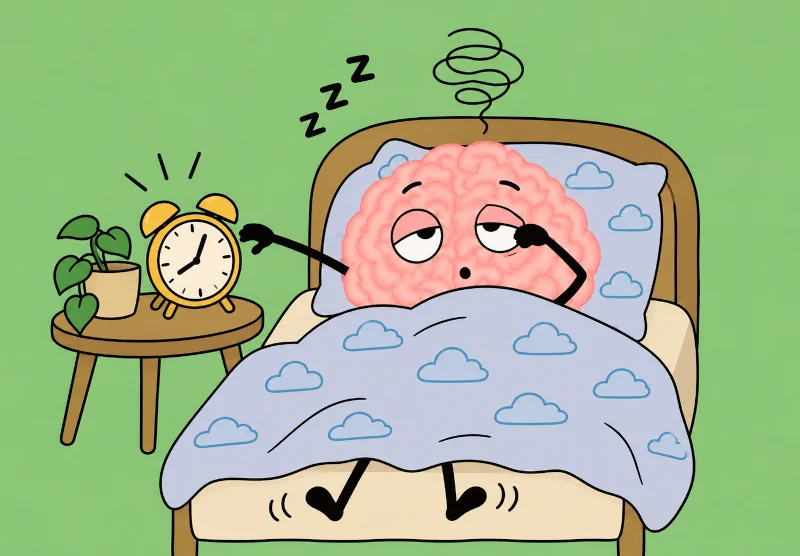
The alarm goes off for the third time, yet you feel as though someone has woken you up in the middle of the night. In the evening, the opposite happens: your energy returns, and sleep refuses to come before 2 a.m.
Usually, this has nothing to do with laziness or a lack of willpower. Instead, it may be caused by a shifted body clock, known as a delayed sleep-wake rhythm. At 7 a.m., your body still thinks it is nighttime. Fortunately, there are ways to reset this mechanism. Below, we explain how it works and what research has to say about it.
Difficulty Getting Up in the Morning – Key Takeaways
- Sleep can be deepest in the morning because your alarm goes off during your body’s biological night.
- This is a typical pattern of delayed sleep-wake rhythm, particularly common among teenagers and young adults.
- Your biological clock is regulated primarily by light exposure.
- Going outside within 30 minutes of waking up can help shift evening sleepiness to an earlier time, even if you get up at noon.
- If these difficulties are accompanied by low energy, depressed mood or anxiety, the underlying cause may be more complex.
What Do Difficulties Getting Up in the Morning Look Like?
Deepest Sleep Just When the Alarm Goes Off
You don’t hear your alarm, or you switch it off automatically without even remembering doing so. Your loved ones say it’s difficult to wake you up.
I Can’t Get Out of Bed
Your body feels heavy, your thoughts are sluggish, and “just five more minutes” turns into an hour. Typical symptoms include:
- Sleeping through several alarms in a row.
- Feeling groggy for the first hour after waking up.
- Having no appetite for breakfast.
A Surge of Energy in the Evening
While everyone else is getting ready for bed, you’re only just getting started. You go to bed at 11 p.m., but don’t fall asleep until 2 or 3 a.m.
This isn’t simply a bad habit. Your body hasn’t started producing enough melatonin, the hormone that signals to your brain that nighttime has arrived.
You Sleep Until Noon at the Weekend
On your days off, you sleep for 10–11 hours and wake up feeling refreshed. This is an important clue: your sleep itself is fine; it’s simply shifted to a later time.
Catching up on sleep at the weekend can make the problem worse. Researchers call this social jet lag, because Monday morning feels like returning from a long-distance trip.
Delayed Sleep-Wake Rhythm – What Does It Mean?
A reversed (or delayed) sleep-wake rhythm means that your internal body clock is running behind the clock on the wall. Your sleepiness, alertness and appetite all shift several hours later.
How Does the Biological Clock Work?
There is a structure in the brain that acts as an internal clock. It tells your body when to raise its temperature, when to release melatonin and when to wake up and become active.
For most people, this internal clock runs slightly longer than 24 hours. Without daily adjustments, it would gradually shift later and later. Light is the strongest signal that helps reset it.
If your body clock is running 3–4 hours late, at 7 a.m. your body is still operating as if it were around 3–4 a.m., as though you were in a different time zone.
Delayed Sleep-Wake Phase Disorder – When Does It Become a Disorder?
When the delay is significant and persistent, specialists refer to it as Delayed Sleep-Wake Phase Disorder (DSWPD). Its characteristic features include:
- Falling asleep and waking up 2–6 hours later than required by your daily schedule.
- Symptoms persisting for at least 3 months.
- Good-quality, sufficient sleep when allowed to follow your natural schedule.
- Significant difficulties at school, work or in family life.
The disorder affects approximately 0.1–0.2% of adults, but as many as 7–16% of adolescents.
Night Owl or Sleep Disorder?
Not every “night owl” has a sleep disorder. A late daily schedule can simply be a natural characteristic, much like height. The distinction lies in the level of distress it causes: chronic sleep deprivation, lateness, and difficulties at school or work.
Around 4 in 10 people diagnosed with delayed sleep phase did not actually have a delayed melatonin secretion pattern. This means that the same complaint – “I can’t get up in the morning” – can have different underlying causes.
Why Do You Sleep Most Deeply in the Morning?
Because your alarm goes off in the middle of your biological night. Two processes contribute to this.
Your Alarm Interrupts Deep Sleep
During the night, we go through sleep cycles lasting approximately 90 minutes, consisting of light sleep, deep sleep and REM sleep (the stage in which we most often dream). Deep sleep, which is the hardest to interrupt, occurs mainly during the first part of the night.
- If you fall asleep at 11 p.m., by 7 a.m. you have long since passed the deep-sleep stage.
- If you fall asleep at 3 a.m., at 7 a.m. you have only been asleep for four hours and may still be in the deepest part of your sleep period.
Your Body Is at Its “Deepest Point of the Night”
Your biological clock regulates, among other things, your body temperature. It usually reaches its lowest point a few hours before your natural waking time, when your body has the strongest drive to sleep.
For someone who naturally wakes up around noon without an alarm, this point occurs in the late morning. As a result, a 7 a.m. alarm goes off right in the middle of their biological night.
What Shifts Your Biological Clock?
Light – The Strongest Signal for Your Brain
There are cells in the retina that are not involved in vision but instead detect light levels. They send information directly to the brain’s internal clock. Timing matters:
- Light exposure during your biological morning shifts your body clock earlier.
- Light exposure in the evening and during the first half of your biological night shifts it later.
Screens and Bright Light in the Evening
Evening light from lamps, televisions or phones signals to your brain that the day is still going on. In one study, reading on a tablet in the evening delayed melatonin release and the onset of sleep.
Caffeine in the Late Afternoon
A dose equivalent to a double espresso, consumed three hours before bedtime, delayed the melatonin rhythm by approximately 40 minutes. Morning coffee is not the problem.
Go Outside for 20–30 Minutes Right After Waking Up – How Does It Work?
One of the simplest ways to shift your sleep-wake rhythm is to go outside within approximately 30 minutes of waking up and spend around 20–30 minutes outdoors, or longer on cloudy days. A walk, having a coffee at an outdoor café or simply walking to the shops is enough. The important thing is to do this every day, including weekends, and avoid going back to bed afterwards.
Why Does It Work Even If You Wake Up at Noon?
What matters is not the time on the clock but your biological morning. You wake up at 12 p.m. and go outside at 12:30 p.m., but for your body, this may still feel like the middle of the night. Exposure to light at this point in your sleep cycle provides a positive regulatory signal, telling your body that it is time to be awake.
As a result, you may start feeling sleepy earlier in the evening, making it easier to get up the following day.
Why Go Outside Instead of Sitting by a Window?
Because it is much brighter outdoors, even on cloudy days. In one study, participants received an average of approximately 930 lux (lux is a unit of illuminance) during the first two hours after waking under normal living conditions, compared with around 3,000 lux while camping (Wright et al., 2013).
Window glass blocks some of the incoming light, which is why going for a walk is more effective than having coffee by the window.
What Do the “Camping Studies” Show?
- After a week of summer camping, participants’ biological clocks shifted approximately two hours earlier. The biggest changes occurred among “night owls”, whose sleep patterns began to resemble those of “early birds”.
- Just one weekend spent outdoors shifted melatonin secretion by 1.4 hours, while a week of winter camping shifted it by 2.6 hours.
These were relatively small studies, but their findings are consistent with what laboratory research on light exposure has established for years.
Is Coffee Alone Enough?
No. Caffeine consumed after waking takes time to work and does not shorten the most intense phase of morning grogginess. It also does not reset your biological clock in the same way as light does.
Coffee is fine – but have it outdoors.
How to Gradually Reset Your Circadian Rhythm?
Your sleep-wake rhythm can be adjusted in small steps, starting with the time you actually get up today.
Step-by-Step Plan
- Set a consistent wake-up time for all seven days of the week. Start with a realistic time, such as 11:30 a.m.
- Go outside every day within 30 minutes of waking up.
- Every few days, set your alarm 15–30 minutes earlier.
- Dim the lights in the evening and reduce screen time.
- Drink caffeine only until early afternoon and avoid long naps.
- Go to bed when you feel sleepy rather than forcing yourself to fall asleep.
Why Not Jump Straight to 7 a.m.?
Moving from a noon wake-up to 7 a.m. means getting up in the middle of your biological night. Light reaching your eyes before your body’s core temperature reaches its lowest point can shift your internal clock in the wrong direction – towards a later schedule (Khalsa et al., 2003). That’s why waking up at noon isn’t a mistake, but a deliberate starting point.
What About Melatonin?
Taken at the right time, melatonin can help shift your sleep-wake rhythm. It acts more like a “dusk is approaching” signal than a sleeping pill. Timing matters more than dosage, so both should be discussed with a doctor.
How Long Does It Take to Reset Your Rhythm?
With plenty of natural light exposure, your biological clock can start responding within a few days. In everyday life, however, the process usually takes several weeks. If your rhythm shifts back again, for example after a holiday, simply return to your plan.
We invite you to get in touch with our IN-MED clinic in Warsaw:
When Are Difficulties Getting Up More Than Just a Delayed Body Clock?
Difficulty getting up in the morning is a symptom, not a diagnosis. There may be several underlying causes at the same time.
Depression – When It’s Not Sleep You Lack, but Energy
People with delayed sleep phase and a genuinely shifted circadian rhythm are several times more likely to experience symptoms of depression. Depression can manifest in different ways: some people wake up at dawn and feel worst in the morning, while others sleep for very long periods and experience so-called “leaden paralysis”, with heavy arms and legs.
The key difference? With a delayed body clock, energy tends to return in the afternoon and evening. With depression, low energy, sadness and loss of pleasure persist throughout most of the day.
ADHD and Late Sleep Onset
In one study, as many as 78% of adults with ADHD experienced chronic difficulty falling asleep, and their melatonin secretion occurred later than in people without ADHD. Morning difficulties in people with ADHD are therefore often related to biology rather than a lack of discipline.
Anxiety and the Bed as a “Safe Haven” from the Day
Sometimes getting up is difficult because the day ahead feels overwhelming, while staying under the covers provides a sense of safety. If getting out of bed is particularly difficult before stressful events, it may be worth exploring the role anxiety plays.
Teenagers – Biological Shifts During Puberty
During adolescence, the biological clock naturally shifts towards a later schedule, and the evening build-up of sleepiness happens more slowly (Crowley et al., 2018). A teenager who struggles to get up for school is often not lazy. At 7 a.m., their body really may still be in its biological night.
Physical Health Conditions
Chronic fatigue can also have physical causes, such as obstructive sleep apnoea (pauses in breathing during sleep), iron-deficiency anaemia, thyroid disorders or diabetes.
Warning Signs You Shouldn’t Ignore
Consulting a specialist is advisable if:
- Despite getting 7–9 hours of sleep, you have been waking up tired for weeks.
- You snore loudly or someone has noticed pauses in your breathing during sleep.
- You fall asleep during the day in inappropriate situations.
- For at least two weeks, you have felt sad or lost interest in things on most days.
- The problem has lasted for more than three months and is interfering with your studies, work or relationships.
Sources:
- American Academy of Sleep Medicine (2014). International Classification of Sleep Disorders, 3rd ed. (ICSD-3). Darien, IL: AASM. Dane o częstości za: 5-Minute Clinical Consult, Delayed Sleep-Wake Phase Disorder.
- American Psychiatric Association (2013). Diagnostic and Statistical Manual of Mental Disorders, 5th ed. (DSM-5). Arlington, VA: APA.
- Burke T.M., Markwald R.R., McHill A.W. i in. (2015). Effects of caffeine on the human circadian clock in vivo and in vitro. Science Translational Medicine, 7(305), 305ra146.
- Crowley S.J., Wolfson A.R., Tarokh L., Carskadon M.A. (2018). An update on adolescent sleep: new evidence informing the perfect storm model. Journal of Adolescence, 67, 55–65.
- Czeisler C.A., Duffy J.F., Shanahan T.L. i in. (1999). Stability, precision, and near-24-hour period of the human circadian pacemaker. Science, 284(5423), 2177–2181.
- Murray J.M., Sletten T.L., Magee M. i in. (2017). Prevalence of circadian misalignment and its association with depressive symptoms in delayed sleep phase disorder. Sleep, 40(1), zsw002.
- Rama A.N., Cho S.C., Kushida C.A. (2009). Normal human sleep. W: T.L. Lee-Chiong (red.), Sleep Medicine Essentials. Hoboken: Wiley-Blackwell.
- Stothard E.R., McHill A.W., Depner C.M. i in. (2017). Circadian entrainment to the natural light-dark cycle across seasons and the weekend. Current Biology, 27(4), 508–513.
- Wittmann M., Dinich J., Merrow M., Roenneberg T. (2006). Social jetlag: misalignment of biological and social time. Chronobiology International, 23(1–2), 497–509.
How to Get to Our Centre?
If you are interested in our treatment and diagnostic services, we warmly invite you to visit IN-MED Centre. We are located in the Bemowo district of Warsaw, at 5 Pełczyńskiego Street, Unit 78.